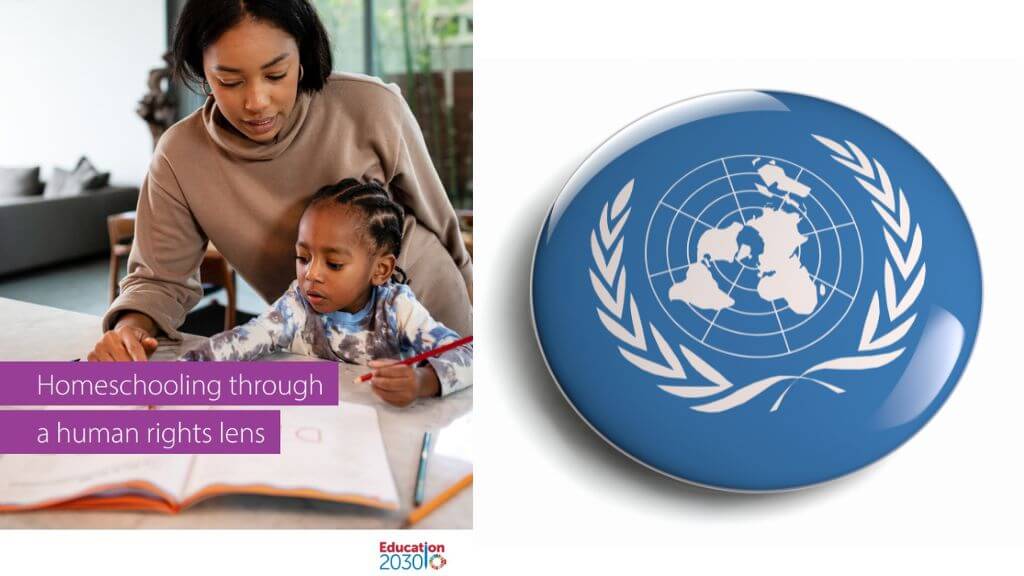
For the first time in its history, the United Nations has directed its attention to homeschooling. On 25 September 2025, the United Nations Educational, Scientific and Cultural Organisation (UNESCO) released a report on homeschooling, titled Homeschooling through a Human Rights Lens. This report, a landmark in the UN’s education work, looks into how homeschooling aligns with international human rights standards, particularly the “right to education.”
Initially, it appears to be a neutral academic analysis. However, a closer look reveals a strong bias toward a framework where governments are expected to regulate, oversee, and enforce minimum educational standards—even within the home.
The report emphasises that while homeschooling is not explicitly addressed in international law, the right to education must be upheld in all settings, including home education. It goes on to affirm parents’ right to choose their children’s education but stresses the state’s duty to ensure quality and accountability through minimum standards. The report also raises “concerns” about the potential limitations of teaching subjects such as sex education, diversity of experiences, social diversity, and citizenship development within homeschooling contexts.
The report appears to have good intentions, but upon closer examination, there are some huge red flags. It recommends mandatory registration (which is already in place in NZ). And is pushing for mandatory periodic assessment or evaluation of student progress or outcomes, to enforce “quality standards.” This would include inspection or supervision rights — including, in some countries, home visits, having programmes that will ensure parents are teaching to State-defined education standards — all under the guise of accountability and children’s rights. In other words, the United Nations wants more state regulation and oversight of home-based education.
The most significant concern is the report’s subtle promotion of overriding parental rights and responsibilities to their children under the guise of children’s rights. While the report acknowledges that parents have the right to direct their children’s education, it also links this right to the state’s ability to set minimum standards. There is an insistence that homeschooling must balance “freedom of choice” (for parents) with state obligations to ensure access, equality, and quality. Even encouraging governments to implement measures that provide home schooling environments, which uphold curricula that are “inclusive” and “non-discriminatory”. However, when it comes to teaching children about traditional gender roles, it becomes an issue, potentially threatening parental rights.
It appears that the freedom and independence that parents have when deciding to homeschool for various reasons, as determined by this report, is a loophole that needs further regulation.
In effect, homeschooling becomes a “privilege” granted only as long as it conforms to the state’s standards. It’s safe to say that this report, in the name of educational equity and human rights, is somewhat of a Trojan horse for regulation and control over the home.
Homeschooling currently accounts for approximately 1.3% of the NZ compulsory schooling enrolments, with a significant increase in numbers during/post-COVID. It is legal but also unregulated, with some measures in place to ensure educational quality and regularity. While UN reports like this are not legally binding, they can significantly influence policy and legislation. The Bible calls parents to educate, protect, train up, and prepare their children for adulthood. One of the great privileges we have in New Zealand is the ability to choose how we educate our children. Whatever that choice might be, let us be vigilant in safeguarding this freedom.
*Written by Family First staff writers*