

Western Australia’s euthanasia and assisted suicide scheme has grown well beyond what was projected, according to the state’s latest annual report. The data raises serious questions about whether the safeguards are working as promised.
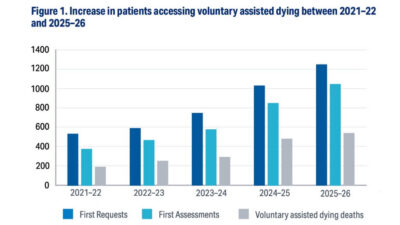
The Voluntary Assisted Dying Board’s report, covering 1 July 2025 to 30 June 2026, records 541 deaths by euthanasia and assisted suicide, about 2.9% of all deaths in the state. That is up from 192 in 2021-22, the scheme’s first year, an increase of about 182%. Of the 541, 508 were euthanasia, where a doctor administers the substance, and 33 were assisted suicide. Since July 2021, 1,764 West Australians have died under the law.
The Board’s outgoing chair, Dr Scott Blackwell, said activity was “more than 10 times higher than predicted at implementation”.
Right To Life UK, a pro-life advocacy group, analysed the report and highlighted several figures:
- Waiting periods waived. The law requires nine days between a patient’s first and final request. This has been bypassed in 648 cases since 2021, or 26% of final requests, rising to 29.1% in 2025-26. One patient died one day after their first request.
- Possible “doctor shopping”. 333 patients (26.7%) made more than one first request. The report says this can happen when a practitioner declines, and the patient seeks another.
- No cases of coercion detected. None of the 1,077 first assessments found that a patient was acting involuntarily or under coercion. Critics question how effectively assessments identify it.
- A small group of practitioners handled a significant portion of cases. Nine practitioners accepted 51.6% of first requests, and eight conducted half of all first assessments, for which A$478.50 can be claimed per completed assessment. Twenty-one practitioners accepted requests without completing the required training.
- Language barriers remain a concern. Six eligible patients spoke no English or only limited English, yet fewer than five received interpreter help at their first assessment, meaning at least two went without.
The reasons patients reported were revealing. The most common, at 74.8%, was being less able to enjoy activities. Other common reasons were a loss of autonomy (59.0%) and dignity (57.1%), followed by inadequate pain control (39.7%). Nearly a third (32.0%) cited being, or fearing becoming, a burden on others.
The number of applicants not accessing palliative care at their first assessment rose by more than 34% in a year, from 124 to 167. Of these, 154 had received none in the previous 12 months. Eleven patients aged 18 to 39 were found eligible this year, and 36 eligible assessments since 2021 have involved that age group.
Nine complications were reported in euthanasia procedures, 1.8% of cases, including coughing, gasping, vomiting and problems with intravenous lines. One patient took one hour and nine minutes to die. The Board does not collect complication or time-to-death data for assisted suicides.
Despite these findings, the Board has recommended reviewing the requirement that patients be expected to die within six months (or 12 months for neurodegenerative conditions), including the possibility of extending or removing these time limits. The Board also seeks to ease federal restrictions to allow telehealth service delivery. Concerns about service delays due to workforce shortages and increased demand have led to recommendations to add resources and expand the workforce.
Dr Calum Miller, medical doctor and research associate, stated, “Western Australia has become the euthanasia death capital of Australia; it really is totally out of control. It is heartbreaking to see such a number and proportion of people wanting to end their lives through assisted suicide or euthanasia.”
Right To Life UK, Chief Executive Alisdair Hungerford-Morgan has called on Health Minister Meredith Hammat to commission an urgent inquiry, including into potential doctor shopping and “whether claimed safeguards in current legislation are protecting vulnerable people in practice”.
The report’s findings come as New Zealand debates changes to the End of Life Choice Act.
The End of Life Choice Act has been in force since November 2021 and includes a six-month prognosis limit. Now ACT MP Todd Stephenson’s proposed End of Life Choice Amendment Bill would replace that limit with a test of whether a person has an advanced, progressive condition expected to cause death. It would also allow a limited waiver of final consent for people who lose capacity after scheduling their death. ACT says the Bill adds practitioner training, stronger oversight and a duty to check for pressure. The ACT party has also promised an Advance Directives Bill next term.
Western Australia’s experience shows that safeguards matter most when someone proposes removing them. New Zealand should not loosen a single limit without an honest and public discussion of where it leads.