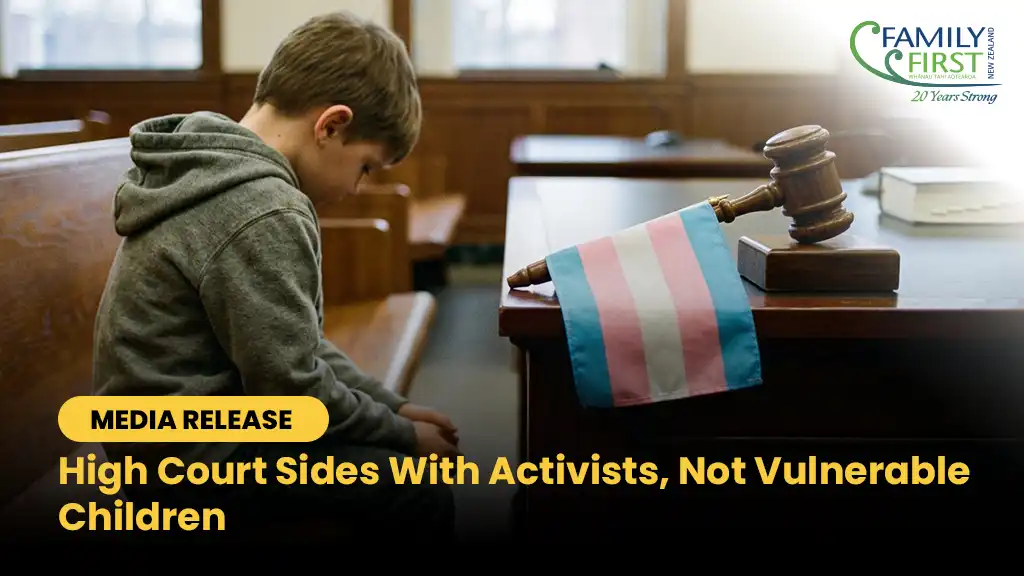
MEDIA RELEASE
4 November 2026
Family First has just released an exclusive podcast discussion between host Simon O’Connor and retired consultant anaesthetist and Genspect NZ clinical director Dr. Isabel Ross.
Dr Ross lays bare the ethical and evidential cracks in New Zealand’s approach to prescribing puberty blockers to children — drawing on her newly published paper in the New Zealand Medical Journal.
The paper — Ethical and Evidential Challenges in Adolescent Puberty Blockage: Why Informed Consent Alone Is Not Enough — contends that paediatric gender medicine has elevated patient autonomy above three equally fundamental ethical obligations: do good, do no harm, and act justly. The result, Dr. Ross argues, is a medical pathway built on flimsy evidence, shielded from scrutiny, and often sold to vulnerable families on the basis of unproven claims.
“Lack of evidence of harm is not the same as safety,” Dr. Ross told the podcast. “If you don’t go looking for harm, you won’t find it.”
The wide-ranging conversation covered the Cass Review’s revelations, the reality of the medical pathway from puberty blockers to cross-sex hormones, the failures of informed consent, and the barriers facing detransitioners — all grounded in Dr. Ross’s decades of clinical experience in risk management and pharmacology.
Some key topics discussed on the show include:
- The 50-fold increase in UK children’s gender clinic referrals between 2010 and 2019 — a surge that in any other medical context would have triggered a public health emergency.
- That over 90% of children placed on puberty blockers proceed to cross-sex hormones, making the so-called “pause” anything but. For many, the pathway leads to irreversible sterility.
- Informed consent is a fiction when children are asked to weigh decisions about fertility and long-term health they have no life experience to evaluate — and parents are pressured by suicide narratives that lack any solid evidence base.
- Exploratory therapy — the cornerstone of differential diagnosis — has been effectively criminalised under New Zealand’s conversion practices law, stripping clinicians and families of the tools they need to properly assess what’s actually going on with a struggling child.
- Detransitioners have nowhere to go. No formal medical pathway exists in New Zealand for those who wish to reverse course. Their existence, Dr. Ross notes, is effectively denied.
This is an important podcast discussion around a medical paper that needs to be taken seriously. Not only is Dr Ross raising ethical questions and concerns, but concerns that involve young children and their families.
About Dr. Isabel Ross
Dr Ross is a retired consultant anaesthetist out of Wellington Hospital. She also has a PhD on patient understanding and informed consent. She is also the Clinical director for Genspect New Zealand.