
The Naked Dictator. Part 2
Bruce Logan – Family First board member
Why has the accusation of racism become so prevalent, causing enough embarrassment to keep many of us silent, when we know that it lacks definition? As indeed it must, because the accusation rests only on a feeling of personal offence, it cannot be supported by appeals to either objective value or scientific method.
Nevertheless, the accusation is intimidating, and it’s meant to be. Despite its murkiness, the accusation has captured the weight of religious conviction in an age when diversity, equity, and inclusion (DEI) is sovereign; denial is akin to blasphemy. To suffer the charge of racism is to be guilty of heresy. The ‘DEI-ists’ are duty-bound to punish the heretic.
Our civilisation is in danger of losing two of the most important bulwarks protecting freedom of conscience. Having rejected the belief that human dignity results from being created male and female in God’s image, we are in danger of losing the conviction that the state is subject to transcendent law, leading us to believe that truth rests on nothing more than what is presumably rational opinion.
The second danger is the growing belief that we are the creators of our own autonomy. Inevitably, interpersonal conflict, the obvious consequence of self-creation, gives rise to a restive society that the state must control. And that must give it increasing power to determine what it means to be human.
The underpinning ideology, cultural relativism, the foundation of DEI, must redefine and replace the traditional expression of objective reality with the sovereignty of the creature. The irony slips by us. Left with no definitive description of who we are, we must ask the state to tell us.
The consequence is that human meaning and purpose are determined by political identity rather than by the dignity described in the Genesis story. And what’s more, the old Genesis story of God-given dignity must be silenced. Indeed, in the attempt to establish the replacement religion, the biblical description of dignity is directly attacked. And with the blind hubris of unobserved irony, dignity is presumed, even if its source is rejected. Dignity is no longer a transcendent truth that gives meaning and purpose to human existence. Rather, racial identity determines dignity.
In this attempt to create a new kind of unfettered human being, a lot is going on under the covers. The first is moral confusion. For example, the perpetrators of the new identity fail to understand the importance of what we once called the cardinal or hinge virtues. They weren’t entirely Aristotle’s baby, but his insights gave rise to the cardinal virtues of prudence, justice, courage, and temperance(self-control).
Aristotle believed, and many who followed him did as well, that the virtues were not isolated from each other but integrated; they work together, depending on one another, under the heading of what we might reasonably call wisdom. And incidentally, that’s a view of virtue that you will find in the biblical book of Proverbs, attributed to King Solomon centuries before Aristotle.
Both Aristotle and Solomon understood the unity of virtue, but more revealing is that they both understood the critical importance of humility, the curse of hubris for Aristotle and pride for Solomon, who was quite sure that the fear of God is the beginning of wisdom. It’s difficult to find even a shadow of wisdom in the accusation of racism.
Up until very recent times. Most of us would have agreed with Aristotle, who thought that a person who truly has one virtue will have them all because virtue involves choosing rightly across the whole of life. He once famously said, “Virtue is not a collection of strengths, but a harmony of the soul.” And that brings me to the three biblical virtues of faith, hope and love, which complete the harmony.
The accusation of racism destroys that harmony by allowing one virtue to swell into a kind of madness, and therefore into a vice. DIE tears justice from its unity with the other virtues, creating a substitute value, unquestionable social justice, which demands a different kind of human being and a different kind of society. The new human being, judged by the doctrine of racism, is righteous only if he or she is deemed not to be racist. Once charged with racism, the victim is guilty as charged until innocence is established.
If racism is to become contemporary society’s original sin, legislation will determine our conception of what it means to be human: primarily a political creation rather than an embodied spirit. The first commandment is stripped of its meaning, and the second commandment loses its cornerstone. Love’s first duty is to self, and godlessness is given cultural sanction.
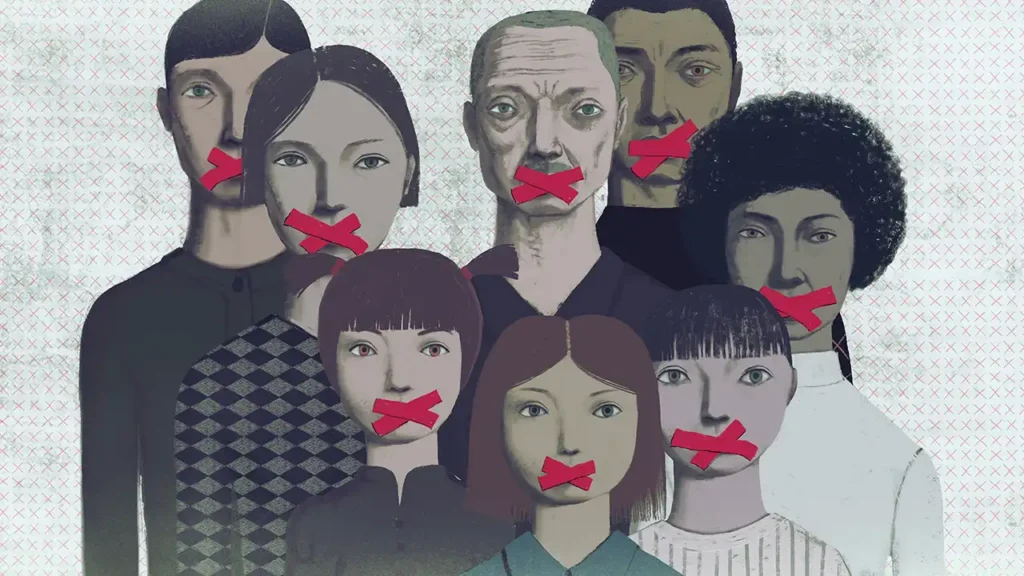
Free speech cannot be free anymore because the charge of racism is underpinned by its assertion that presumes to defend the new autonomous human being. The individual man or woman must find his or her raison d’être in the innumerate arithmetic of race rather than in a created and shared humanity. That’s why, in spite of having no clear definition, “race” cannot be criticised or even examined. The reductionist racial supplant of who we are is not open to scrutiny; it is so deeply embedded in the cultural psyche that it must be the bottom line of identity.
With penetrating irony, the moral panic that would make the charge of racism universally necessary has its roots in an evacuated version of Christianity. The charge of racism is not a consequence of respect for the individual, but rather the opposite. Loyalty to the tribe overrules the sacredness of the individual.
Legislation based on the legitimacy of racism is the great vacuous invention of our time. In the philosopher Charles Taylor’s terms, it is a product of an ungrounded “social imagination”. In old-fashioned language, it’s a fantasy that would reinforce the presumption of victimhood.
The most terrifying thing about the charge of racism is that the accused is guilty simply because the charge has been made. The legal imperative of centuries, innocent until proven guilty, is turned upside down. The accused is guilty and forced to prove his or her innocence and undergo a lengthy pseudo-legal process that, slowly revealed, is the punishment.
The recent delayed sentencing of Vickrum Digwa, a 23-year-old Sikh, for stabbing and killing Henry Nowak, an 18-year-old university student, in Southampton, England, reveals how the charge of racism can inhibit justice. When the police attended the crime, Digwa claimed he had been racially insulted. The police, conditioned as they are, didn’t listen to Nowak’s pleas and handcuffed him, refusing to believe he had been stabbed. The clamour of racism rang in their indoctrinated ears. Nowak died after his pleas had been ignored for 8 minutes. Digwa finally admitted he had not been racially insulted.
The charge of racism masters reason, giving protesters an excuse to justify their protests. That is especially true when the police are trained in diversity doctrine. In New Zealand, we haven’t had a situation as dramatic as the one in Southampton. Nevertheless, the shorthand charge of racism is endemic. Many of us, to avoid looking like a pariah, tend to slip too easily into self-censorship, and, for example, rational discussion becomes impossible. Perhaps the most important of the cardinal virtues, courage, which gives the confidence to dissent, is called bigotry.
Because the contemporary accusation of racism is so ill-defined, it must create an atmosphere where thought crime becomes increasingly possible. Hate speech legislation, the ultimate weapon of those who shout racism, attempts to criminalise what it thinks we think and then tells us what we should be thinking.