
The religion that thinks it’s neutral – By Bruce Logan, Family First board member and longtime cultural commentator.
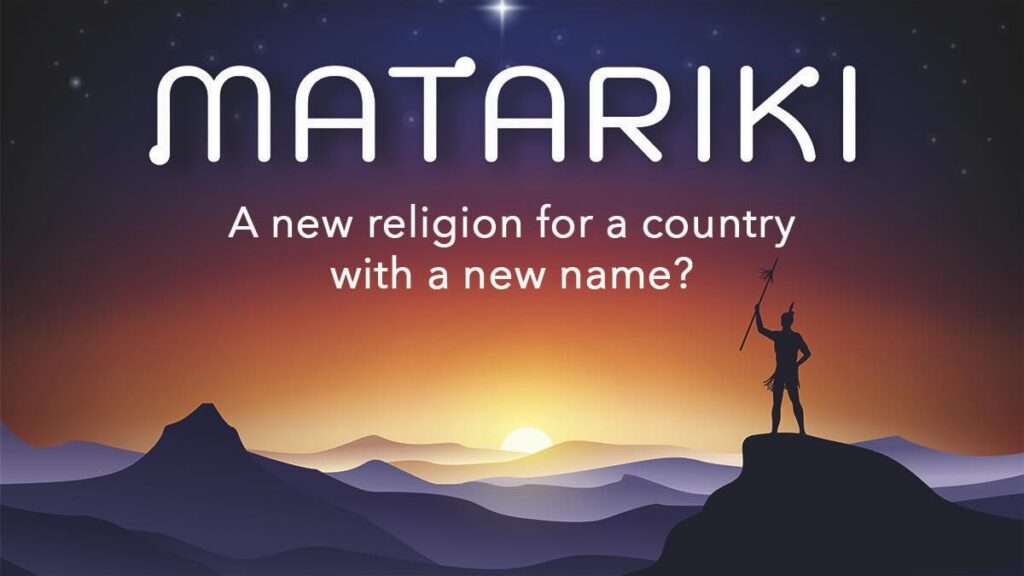
Aotearoa has just had its fifth annual prescribed observance of Matariki, civil religion’s avant-garde in New Zealand. A new religion for a country with a new name.
So what is a civil religion? The first time I heard the term was in 1996, in a conversation with the theologian Harold Turner. Like many New Zealanders, I didn’t have a clue what a civil religion might be. Now, in 2026, I know better because it’s here, state-sponsored and state-supported, seducing as it embraces.
For a long time now, we have been living through the cultic fantasy of diversity, equity and inclusion. The ‘gospel’ of cultural relativism has been shaping the way we think about the world. All religions and all spiritual claims have been declared equal. It might have worked for a while, but in the real world, we can’t have it; somebody has to be the boss. We need a secular religion for a secular age; a civil religion. Let me explain.
A civil religion operates in the opposite way to traditional religion, and in New Zealand, that is Christianity, a grassroots religion that has shaped Western culture’s private and public morality for nearly two millennia, and New Zealand’s since the Treaty of Waitangi. Beliefs we still precariously hang on to about human dignity, human rights, common law, the way we should treat each other, and our understanding of the natural world found their raison d’être in the Hebrew and Christian Scriptures. They remain, despite a growing ignorance of their source, the only lubricant we have for our squeaking democracy. They have been with us for so long that we’ve come to believe they are universal, discovered through the application of reason. And that’s what we mean when we talk about a secular society. It is assumed that the biblical ethics that have guided us for centuries are, in fact, universal and not the revelation of Christianity. The great vanity of the Enlightenment that gave the French Revolution its energy continues to deceive.
A secular society is a parasite. Because it can offer no values of its own, it copies Christianity’s morality, yet it rejects it as an authority of any kind. It claims political neutrality while presuming an ethical superiority that allows it to judge any other religion, philosophy, or ideology. This is the cradle that nurses a civil religion.
A civil religion is not a grassroots affair. It is a state-sponsored religion hostile towards Christianity and a subsequent replacement for it. Consequently, the old foundation for objective truth and order can no longer be found in the revelation of a biblical God revealed to us in Jesus Christ. The uniqueness of the Genesis story is not recognised; call it a myth if you must, it remains unique. Its declaration that we have been created by God in his image, male and female, remains the only foundation we have to support the dignity and freedom of the individual. Deny the meaning of the Genesis creation story of man and woman, and questions about human origin and destiny must become matters of opinion.
Initially, civil religion, with its emphasis on diversity and inclusion and a great deal of chatter about equity and freedom, might appear sympathetic to Christianity because it has grown out of it. In fact, believing that it can retain traditional morality without God and still discern right from wrong through reason alone is the grand illusion of the secular dream.
A little history: the ancestors of “Diversity” during the French Revolution did not accept that they were the victims of any grand illusion, although their attempt to install the ‘Cult of Reason’ in Notre Dame Cathedral lasted a mere seven months. It remains one of the most striking examples of de-Christianisation, and the cult of the Supreme Being promoted by Robespierre after the Cult of Reason’s failure was one of Western Civilisation’s first attempts to create a civil religion. Karl Marx followed in his attempt to instil the cult of reason under the cover of ‘scientific socialism’.
So the new system that would shape our culture, claiming to be morally and politically neutral, is called secular. The religion that is not religious, however, has its Achilles’ heel. Because it is a political creation, it cannot pluck a national story out of the air. It must find its mythology and festivals elsewhere, and conveniently, it can manipulate Māori mythology and festivals to lend an aura of undemanding spirituality. Under the cover of diversity and inclusion, it can return to the dark gods worshipped by pre-colonial Māori, which is cast as nothing more than respect for an indigenous people.
The creation of Matariki as an annual festival is the clearest evidence of New Zealand’s evolving return to paganism. So we should not be surprised that we now have wall-to-wall government-sponsored propaganda of its nature and virtue. And in that context, we should not be taken in by the accusation that Christmas and Easter have Pagan connections; their Christian emphasis and meaning remain obvious. New Zealanders are being given a default secular religious foundation infused with pantheism. That’s why advocates of the new religion can apparently claim, without embarrassment, that ancient Māori knowledge has the authority of the scientific method.
Nga Kete Wananga o Otautahi (Christchurch Public Library) tells us with overreaching confidence, “The Māori New Year has always been celebrated with the rise of the star cluster Matariki. The rising period is from Hurae/July 6 to 13; the public holiday of Matariki is on Friday, July 10, 2026.” ‘Always’ is the overreacher. It makes it sound as though we know a great deal more about Matrika’s history than we really do. Its origin and celebration among tribal Māori is uneven and unclear, to say the least. But that doesn’t matter because what really matters is the creative restoration of a mythology to sustain the new religion. You might say, with a rush of blood to the head, that it resembles a vain and inglorious imitation of Virgil’s attempt to create a mythology for Caesar with his “Aeneid.”
We are told how to pray in Māori.
Manawa maiea te putanga o Matariki/Manawa maiea te ariki o terangi/Manawa maiea te Matahi o te tau,
The translation is;
“Hail the rise of Matariki/Hail the lord of the sky/Hail the Māori New Year.”
And again, in translation, we have;
“Great Hiwa, long established Hiwa, skilled Hiwa, wise Hiwa! Hiwa Hiwaiterangi. This is the wish of the desiring heart. Spread out in plenty the multitude of immense opportunities. Hold fast to succeed, hold firm to good fortune! Go forth into the world and prosper.
We are also told how we should celebrate our civil religion. The list is exhaustive, but a few examples will do to give the flavour. We could, for example, clear the weeds from the Whanau graves and tidy up the weeds. Read our Tamariki stories to educate them in Māori Myth. Learn more about how we can care for our Mother Earth, Papatuanuku. Fly Kites. Each suggestion is innocuous enough, perhaps, but the context is critical.
Perhaps the most important issue is the impact that civil religion has on our understanding of human dignity and freedom. God-given dignity, described in the Genesis creation story that men and women have been created in God’s image, is lost. The authority of civil religion, dignity, and identity is conferred on us by the state. Original sin is no longer a failure to believe what God has revealed to us about ourselves. Rather, it is the failure to accept the state’s declaration of our identity. There is no forgiveness, no grace, and no way out. A major legal tool will be hate speech legislation.
The essence of Matariki is opposed to the heart of the Christian faith, the concept of dignity and freedom that faith has given us. Matariki can offer nothing about human meaning that we don’t already have. We find ourselves confronting a massive religious, cultural, and political irony. Māori converted in large numbers to Christianity in the mid-19th century. They gave up their traditional gods, and they remained Māori. Religion was not confused with culture. Thousands of Māori remain Christian to this day. Matariki, with its fixation on precolonial Māori myth, would take us all back to precolonial times and intensify our sense of separateness.
Dr Rangi Matamua, perhaps the most important adviser to the government about Matariki, believes that pre-colonial beliefs and spiritual rituals should revive the old Māori gods. He wants to reconstruct the Māori religion for the postcolonial Aotearoa. He would like Matariki to become the new national story, the cradle of every New Zealander’s identity. The use of ‘post-colonial’ in this context is revealing. Politics would shape the new civil religion, which is, of course, the rules of the game.
Finally, the civil religion that would sustain Matariki is not a grassroots affair. According to research done by the University of Wellington, 24% of Māori still claim to be Christian, while over half have no religious affiliation at all. But even more revealing, in 2020, only 6.4% supported Atua, a 1.5% decline from 2013. That would tend to affirm the claim that the demand for Matariki is not coming from Māori at all. Rather, it is coming from a small group of secular academics convinced that Christianity is the villain. Driven by their belief in critical race theory and their ‘white guilt’-infected hatred of their particular version of colonialisation, they want a new religion. There is nothing original in what they are doing; they are participating in a trend that is proceeding apace in every Western country, the deliberate de-Christianisation of the private and public ethic and the erosion of the West’s historical story.