
The deadlock of political emptiness
Bruce Logan – Family First board member
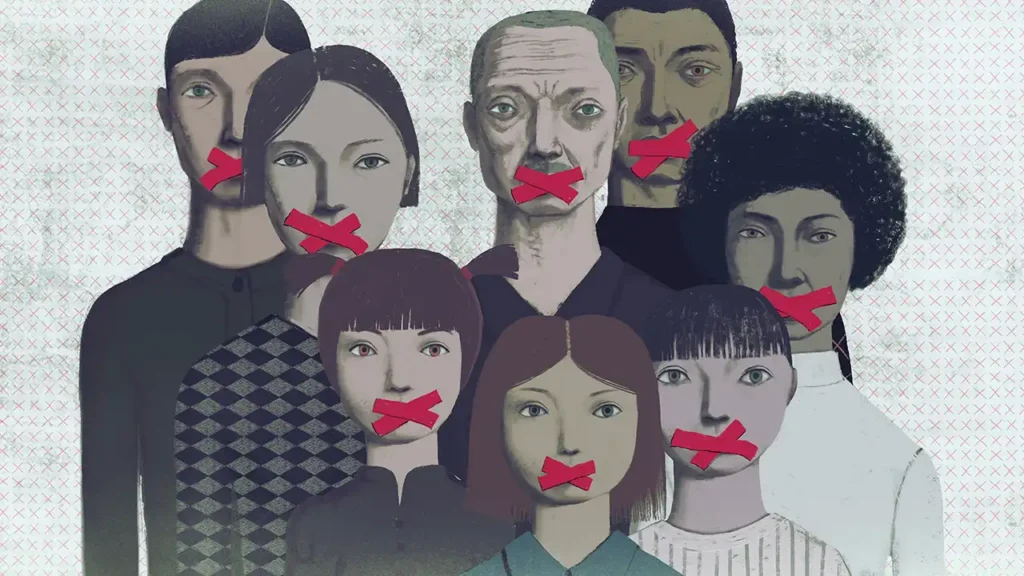
I came across a magnificent quote recently from Max Picard (1888-1965), the Swiss philosopher who wrote “The Hitler in Us All.” Alas, I haven’t bought the book because it’s rare and expensive at $145 on Amazon AU. Anyway, the quote is “For emptiness has no language.” For an old-fashioned believer like me, that is encouragingly resonant. Along with the book’s title, it puts my imagination into overdrive.
“Emptiness” appealed to me because it’s a vivid description of the society that’s hostile towards the faith that gave it life. A second book by Picard, which I did manage to buy, “Flight from God”, reinforced the cause of my discomfort. Quite suddenly, well, perhaps not quite so suddenly, but certainly in the last few decades, Western civilisation is left with a broken foundation. And that brokenness has reached its nadir in my maturity. Has a generation ever been so bereft, so divorced from its past? When I was a young man, we were in no doubt about our foundation. If I may plunder Robert Browning, God was still in his heaven, and all was right with the world. Well, sort of right.
And here, another descriptor of our time by Picard comes to mind. The period in which we live is “discontinuous.” I couldn’t help thinking about what we have come to call the political left, I suspect largely because “discontinuous” describes its loss of relationship to its source, Fabianism, a baffling blend of Marxism with Christianity. Well, that seemed to be the case in 1884, when the Fabian Society was founded. Now, in 2026, the Fabian Society’s Manifesto reads like a document defending “diversity, inclusion and equity.” It has lost any recognition of humanism’s debt to Christianity. Sure, the Fabian Society in 1884 was supported by atheists, G.B. Shaw, Sidney and Beatrice Webb, and others. Nevertheless, the Fabian Society, with its belief in ‘evolutionary socialism’, owed much to Christianity.
However, I am not claiming that the left is the only villain in the game suffering from historical amnesia; the so-called political right has lost its focus as well. It has rendered conservatism an anaemic exercise. Politicians, who might consider themselves conservative, don’t seem to have any skin in the game, and if I can extend the image, they are not prepared to receive a bloody nose. A conscience manipulated by the diversity cult would make cowards of us all. There might be some kind of aesthetic connection, but even that’s hard to find. The connection of conservatism to truth and freedom, let alone beauty, has certainly become “discontinuous” with the traditions that sustain it. And what’s more, they have become disconnected from each other. It doesn’t help much if we call the left progressive and the right conservative. Both words have been emptied of meaning.
It was the philosopher Roger Scruton who suggested that conservatism is about holding on to those things we love. But what do conservatives love? And do they understand that love must be nourished? One suspects that conservatism is in decay because it no longer knows what to love. Its enemy, the progressive left, would no doubt claim that it exists only on the strength of nostalgia’s poignancy.
Nevertheless, the conservative instinct remains deeply embedded in the human heart. It is not an ideology that demands legal protection like the progressivism of the left. Indeed, it cannot, because it depends on the warm and confident comfort of traditional truth. It supports a civil society, sustained by strong families and its institutions. Its lifeblood is a shared tradition and intergenerational continuity. It’s a way of life that depends on its roots. It cannot be imposed by the state onto its citizens. Rather, the citizens determine the nature of the state.
I’m not surprised that the ‘Left’ and the ‘Right’ have wandered into the “emptiness” that has no language. Both have been left with insufficient linguistic power to describe themselves convincingly. The language of right and wrong, good and evil, has been subsumed by the pretentiousness of the diversity cult, which has created its own changing version of right and wrong, good and evil.
There is an election coming up, and the parties on the left are obsessed with a range of demands that require wealth redistribution. Seduced by the heretical gospel of equity, frequently called social justice, they seem to believe that equality of outcome will lead us to the gates of Utopia. They fail to accept that their Gospel is a bushfire of Marxism and bowdlerised Christianity that burns up all its fuel, which can only increase the power of the state over every citizen.
In the 18th century, Jean Jacques Rousseau told us what social justice is “the equality which nature established among men, and the inequality which they have instituted among themselves. Rousseau, like his acolytes in the modern left, has everything exactly backward. Nature did not establish an equality among men. And any attempt to achieve that is not a return to nature. Rather, it is an invitation to tyranny because it denies reality, which the state must reorder to fulfil the fantasy.
At the heart of the social justice movement is the belief that disparities in wealth and status are evidence of exploitation and discrimination. However, such an ideology is superficial. Even in a society that takes equal opportunity seriously and judges people from different backgrounds according to their perceived disadvantage, there is so much we cannot control. For example, people develop specialised capabilities over time to do specific things. That’s why we have Italian cuisine, German beer, or French wine. In the real world, quality and competence always demand a premium.
The Right is unable to act as a counterweight because it doesn’t seem to comprehend that it has become a riddled bucket of rootless flowers taken inside to die, unable to reproduce. It has forgotten how to love the garden of its own history. Unlike the 16th-century politician and poet Andrew Marvel, we can no longer enjoy “green thoughts in a green shade.”
And that, I dare to say, is our problem. Progressivism lusts after its imaginary future, and conservatism would love its past if it could remember it. Both reverberate with the poignancy of what the novelist George Eliot said in the 18th century.
“Three words have often been used as the trumpet call of men.—the words God, Immortality, Duty—pronounced with terrible earnestness. How inconceivable was the first, how unbelievable was the second, and yet how peremptory and absolute the third.”
Eliot’s remarks are particularly distressing, not only because they offer insight into the life of one of our greatest novelists, but also because they describe the contemporary state of mind of both progressivism and conservatism. Progressivism now hates God, and immortality is a fairy tale. But it is still driven by its sense of duty, not to God, but to itself. It cannot understand the dark humour of its own irony. Conservatism can’t bring itself to say that its understanding of life depends on God. Belief in immortality is an exercise in nostalgia. Duty remains, but the God to whom it is owed remains on the sidelines. Conservatism can’t speak out except in a reactionary way. It doesn’t seem confident enough to claim that the biblical roots sustaining conservatism are the same as those sustaining the entirety of Western culture. In the meantime, the culture war continues apace in a world that struggles to find a language to contain it.